How to use borax as ant killer: Best guide
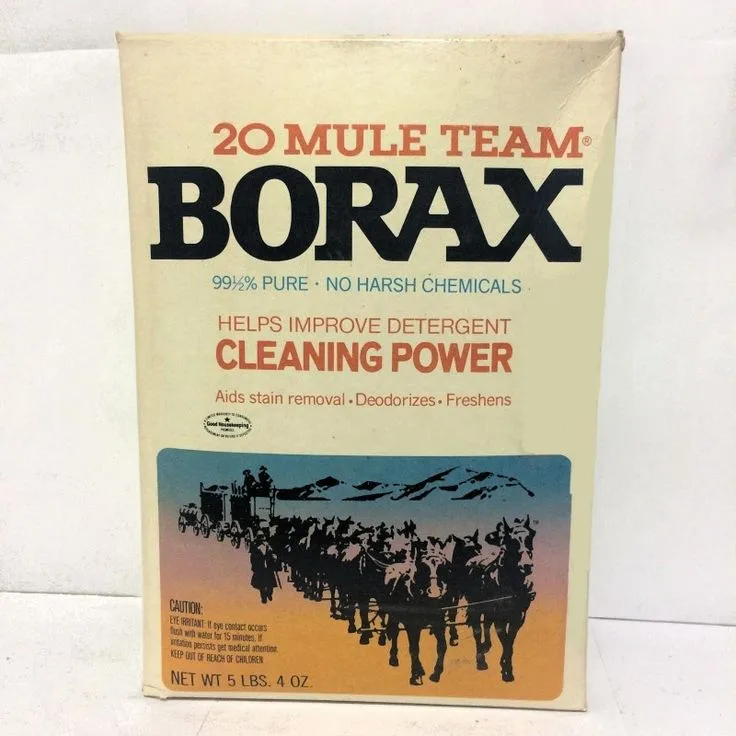
You've got a line of ants on the counter and you're figuring out how to use borax as ant killer without turning your kitchen into a spray zone. It's a fair question. A 4-ounce box of borax plus a cup of sugar can take down an entire colony in about a week.
Borax (sodium tetraborate decahydrate) works as a slow-acting metabolic disruptor. The forager ingests it, walks back to the nest, and feeds it to the queen via trophallaxis. That's the colony-kill mechanic.
As of 2026, the EPA still lists borax as an excluded-use material for consumer household applications. So let's walk through exactly how to set it up so the whole nest goes, not just the two ants you can see.
Quick Answer: Why Borax Kills the Colony Instead of Just the Foragers
Mix one part borax to three parts sugar. Place small dabs along the ant trail, not at the nest. Let foragers feed and carry it back to the queen.
The colony collapses within five to ten days. No sprays, no repeat visits.
Know Your Situation Before You Mix Anything
Before you open the box, spend two minutes checking your conditions. The right bait form and placement shift based on a few variables.
- Indoor vs. outdoor: If the trail runs inside your kitchen, use a liquid bait. Granular holds up better outside where moisture is lower.
- Humidity above 75% RH: Granular clumps within three days in Florida, Louisiana, or Gulf Coast climates. Switch to liquid or seal it in a container.
- Season matters: Spring and early fall, ants forage on sugar. Mid-summer (July through August), they shift to protein. If your sugar bait gets ignored, that's why.
- Kids or pets on the floor: Keep dabs elevated on cardboard or a raised platform. A toddler can grab loose granules.
- Multiple trails vs. one: One trail means one placement zone. Three or more trails usually means a large or split colony. You'll need to treat each entry point separately.
If you're dealing with fire ant mounds in the Deep South, the granular barrier approach works differently. You're not baiting foragers. You're creating a kill-zone line around the mound.
What You'll Need: Materials, Ratios, and the Two Bait Forms
You don't need much. Here's the full list.
| Item | Granular Bait | Liquid Bait |
|---|---|---|
| Borax | 2 tablespoons | 1/2 cup |
| Sugar (granulated) | 6 tablespoons | 1 cup |
| Water (warm) | None | 1 cup |
| Container | Cardboard or wax paper | Cotton balls or open cup |
| Approx. yield | 40 to 60 dabs | 8 to 10 cotton ball loads |
The 1:3 borax-to-sugar ratio for granular and the 1:10 ratio for liquid are the ones that work. More borax makes the mix taste bitter to the ants. They reject it.
Too little and the dose isn't lethal once it reaches the queen.
For the summer protein switch, swap the sugar for peanut butter. Mix 1 part borax to 3 parts creamy (not crunchy) peanut butter. Same ratios, different attractant.
The mechanism is identical.
You'll also want a pair of scissors, a spoon for mixing, and something to elevate the bait. A piece of cardboard, a coffee lid, or wax paper all work. OSHA's safety data sheet for sodium tetraborate notes it's mildly irritating to eyes and skin at high volumes.
At bait quantities, you're fine.
Step-by-Step: Mixing and Placing Your Borax Ant Bait
Here's the full workflow from mix to colony collapse.
Decision branch: granular or liquid?
If the area is dry (kitchen counter, outdoor concrete, low humidity): Go granular. Stir 2 tablespoons of borax into 6 tablespoons of sugar until evenly mixed. It should look like coarse, slightly gritty sugar.
No clumps.
If the area is damp (under-sink cabinet, crawl space, high-humidity climate): Go liquid. Dissolve 1/2 cup borax in 1 cup warm water. Stir in 1 cup sugar.
Pour into open containers or soak cotton balls. Liquid lasts longer in moisture. Granular hardens and stops attracting.
Decision branch: sugar base or protein base?
If it's spring, fall, or early winter: Sugar base. Ants stockpile carbohydrates for the colony. They'll hit sugar bait hard.
If it's July or August and sugar bait gets ignored after 48 hours: Switch to peanut butter. Mix 1 part borax to 3 parts creamy peanut butter. The protein triggers the foraging response in summer.
Give it 72 hours before calling it a failure.
Step-by-step placement:
- Track the ant trail to its food source. Note the entry point on your floor or counter.
- Place 4 to 6 dabs of granular (or 2 cotton balls for liquid) along the trail. Space them 4 to 6 inches apart.
- Set them on a piece of cardboard or wax paper. This keeps the bait off bare surfaces.
- Do not spray, sweep, or disturb the foragers. They need to eat the bait slowly.
- Check back at 48 hours. You'll see foragers slowing, dropping, or dragging.
- Days 5 through 10: the queen ingests the accumulated dose. Brood production stops. The colony collapses.
- If the trail is still active on day 10, reapply. If it's gone, stop.
Where to Put It and the Three Placement Rules That Make or Break the Result
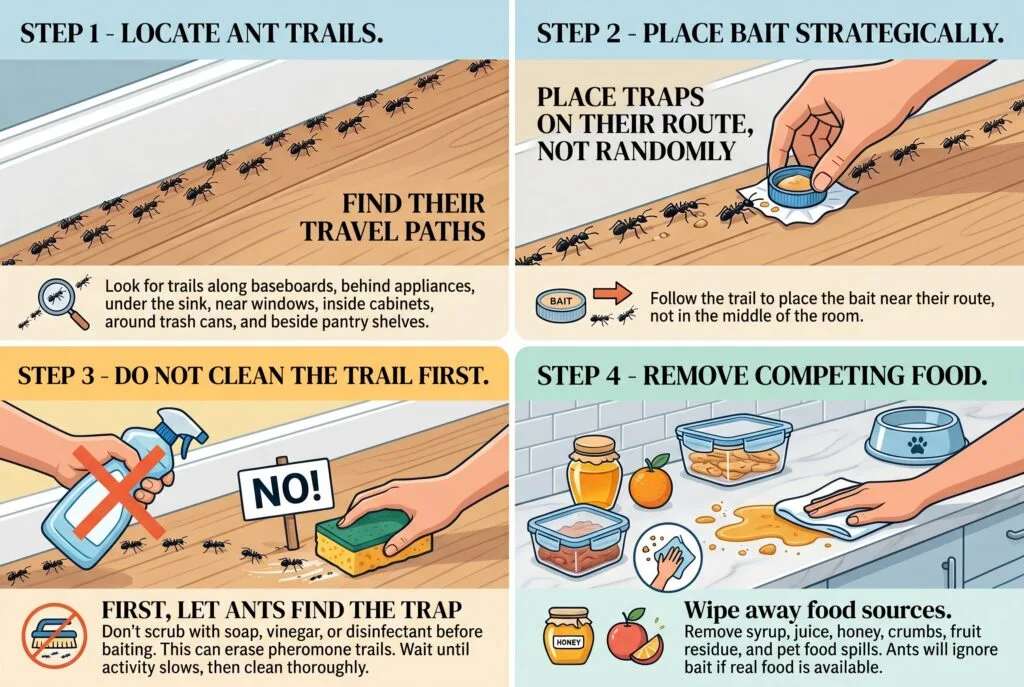
Placement is where most DIY borax attempts fail. You put it in the wrong spot, the ants never find it, and you assume it doesn't work. Three rules keep you on track.
Rule 1: Bait the trail, not the nest. You don't need to find the underground colony. You need the foragers to hit your bait on their regular foraging walk. Place dabs where you see the line of ants.
That's the whole idea.
Rule 2: Elevate and isolate. Loose granules on bare tile get kicked around, washed by a sponge, or grabbed by a dog. Cardboard, wax paper, or a raised coffee lid keeps the bait contained and visible.
Rule 3: One trail, one zone. If you've got a trail on the counter and a trail by the back door, that's two zones. Treat each independently. A single colony can split into satellite groups.
You need to hit each foraging route or the unserved group re-establishes in two weeks.
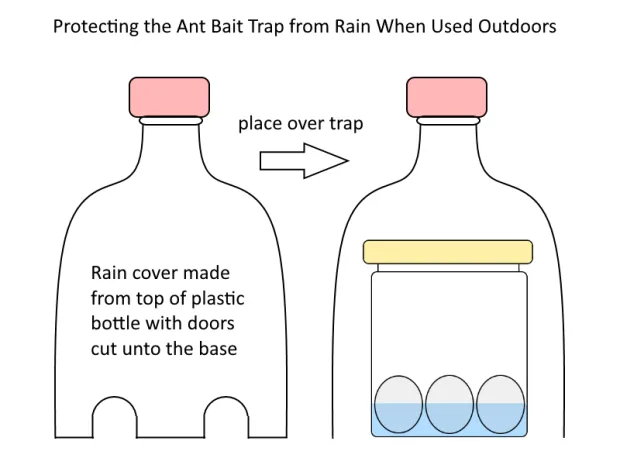
Outdoor note: If you're running a granular barrier along a foundation or crawl-space perimeter, space dabs every 15 to 20 feet. Reapply after any rain heavier than a light shower. The granules wash off bare soil fast.
The 10-Day Timeline: Forager Die-Off, Queen Ingestion, and Colony Collapse
The kill doesn't happen overnight. Here's what actually unfolds, hour by hour.
| Day | What's Happening | What You'll See |
|---|---|---|
| 1 to 2 | Foragers ingest bait on the trail | Ants slowing, dragging crystals back to entry points |
| 3 to 5 | Trophallaxis spreads borax to workers and the queen | Visible forager drop-off on the trail |
| 5 to 10 | Queen ingests accumulated dose, brood development halts | Trail thins dramatically, then vanishes |
| 10 to 14 | Remaining brood fails to mature | No new foragers appear |
If the trail is still fully active on day 10, you've got a reapplication trigger. Add a fresh dab set. If foragers are sluggish and the line is broken, you're in the final stretch.
Don't reapply yet. Let the cycle finish.
The whole mechanic works because borax is non-repellent. The ant doesn't "feel" it and run. It eats, walks home, regurgitates the mix for the queen, and the dose compounds across the colony.
Sugar Bait Going Unnoticed? Switch to the Summer Peanut-Butter Formula
Yes, it's a seasonal foraging shift, and you can override it in under two minutes. From late June through August, many ant species (odorous house ants, pavement ants, fire ants) prioritize protein over carbohydrates. They're building the next generation.
Swap the sugar for creamy peanut butter. Keep the same 1:3 borax-to-attractant ratio. Mix 2 tablespoons borax into 6 tablespoons smooth peanut butter.
Roll into pea-sized balls. Place them where the sugar dabs were.
Give the new bait 72 hours. If foragers start dragging the peanut balls, you're back on schedule. If they still ignore it after three days, the colony is deep in its protein-heavy phase.
Wait until September for the sugar switch to reignite.
Five Mistakes That Turn a Working Bait Into a Useless Pile of Crystals
We see these in aggregate user feedback almost every time. None of them require a new product. Each one is a placement or timing error.
Spraying the ants first. You spot the trail, grab a bottle of soapy water, and nuke the line. Now the foragers are disoriented. They won't walk a dead-straight trail to your bait. Wait 24 hours for normal foraging to resume, then place the bait.
Putting bait at the nest entrance. The nest is underground, in a wall void, or under a concrete slab. You can't reach it. Bait the trail, not the hole.
Using a 1:1 borax-to-sugar ratio. That's way too bitter. The ants taste the bitterness and walk past. Stick to 1:3 granular or 1:10 liquid.
Reapplying on day two. The colony hasn't cycled the poison yet. You dilute the dose. The foragers get a sub-lethal amount instead of a lethal one. Wait the full 10-day window.
Leaving granules in a 90% humidity crawl space. They clump in 48 hours. The texture changes. Ants reject hard, crystalline chunks. In high-RH zones, use liquid or seal the granules in a perforated container.
Keeping Borax Safe Around Toddlers, Dogs, Cats, and Kitchen Counters
Borax is low-toxicity at bait quantities, but "low" doesn't mean "zero," especially for a two-year-old who grabs everything off the counter.
- Toddlers: Keep dabs on elevated platforms (cardboard stacked on a shelf, a raised coffee lid). Never leave loose granules on the floor at ankle height. Store the unopened box on a high shelf.
- Dogs and cats: A single dab is below the ingestion threshold for most pets. A cat licking a full tablespoon can get vomiting and lethargy. Place pet-zone bait in open-topped cups where paws can't reach the granules directly.
- Kitchen surfaces: Wipe down any counter or cutting board that touched the cardboard. Borax isn't a food additive. The FDA does not list it as GRAS for human consumption.
- Garden soil: Don't build a long-term borax line through raised vegetable beds. Boron accumulates and causes phytotoxicity in tomato, squash, and leafy greens after a few weeks.
- California households: Prop 65 requires a warning label on borax products for chronic exposure. At consumer bait levels, the risk is negligible. The warning covers occupational, high-volume scenarios.
If a child does ingest a small amount, call Poison Control at 1-800-222-1222. A teaspoon or less is unlikely to be a medical emergency, but don't guess.
Building an Outdoor Borax Barrier Around Your Foundation and Crawl Space
The goal here is different from indoor baiting. You're not asking a forager to walk into a dab. You're building a line the colony has to cross, and every ant that crosses picks up a dose.
Run a continuous granular line of borax-and-sugar mix along the foundation. Space it every 15 to 20 feet for a residential slab. At crawl-space entries (floor drains, utility penetrations, the gap under the slab), drop a small dab on the inside edge.
Two practical notes from our research:
- Reapply after any rain heavier than a light shower. The granules dissolve off bare soil within 2 to 3 hours in a downpour. A thin layer of mulch or gravel over the line extends its life by days.
- For fire ant mounds in the Gulf region, the barrier approach has limited range. Mounds sit 30 to 50 feet from the trail. The forager won't carry the dose back far enough. You need a mound-specific treatment for those.
When Borax Isn't Cutting It: When to Reapply, Step Up, or Call a Pro
Reapply once if the trail is still active on day 10. Same ratio, same spot, fresh mix. Give another 10 days.
If the trail persists past day 20, or you're seeing multiple species in one kitchen (small-headed ants on the counter, odorous house ants on the windowsill), the colony is either too large or split into satellite groups. At that point, a single DIY bait line isn't enough.
Call a pest professional when:
- You have structural wood-damage ant species (subterranean termites coexisting with fire ants).
- The infestation spans two or more rooms with independent entry points.
- You've done two full borax cycles and the trail resets within 48 hours.
A pro will apply a bifenthrin or fipronil perimeter plus targeted bait stations. That's a different tool. Borax is your first response, not your only one.
Quick-Reference Decision Guide: Pick Your Method in Under a Minute
| Your situation | What to do |
|---|---|
| One indoor trail, dry climate | Granular, 1:3 sugar, 4 dabs on cardboard, 10-day wait |
| One indoor trail, high humidity | Liquid, 1:10 sugar, cotton balls in open cup |
| Summer, sugar ignored for 72 hrs | Switch to 1:3 peanut butter balls |
| Outdoor foundation, dry season | Granular line every 15 to 20 ft, reapply after rain |
| Two or more trails, day-20 reset | Reapply once, then escalate to a pro |
| Fire ant mounds, Gulf South | Mound-specific treatment, not a perimeter line |
Frequently Asked Questions
Does borax actually kill the ant queen?
Yes. The queen ingests borax through regurgitated food from foragers (trophallaxis). The cumulative dose halts brood production within 5 to 10 days.
Without new workers, the colony starves and collapses. The queen dies of metabolic failure, not a single lethal hit.
Is borax ant bait safe for cats and dogs?
At normal bait quantities (a few granules), it's below the toxic threshold for most cats and dogs. A large ingestion, like a cat licking a tablespoon, can cause vomiting and lethargy. Keep dabs off the floor and use elevated cups in pet traffic zones.
How long does a batch of borax ant bait stay effective?
Granular mix kept dry lasts 4 to 6 weeks. In humidity above 75% RH, it clumps and loses attractiveness within 3 to 5 days. Liquid bait in a sealed container holds for about 2 weeks.
Reapply when foragers stop touching the bait.
Can I use boric acid instead of borax?
You can, but boric acid is faster-acting and more acutely toxic. It's a better fit for sealed bait stations in commercial settings. For open household use around kids and pets, borax's slower onset is safer.
The colony-kill mechanism is the same.
What do I do if the ants are eating the bait but the trail doesn't stop?
The colony is larger than a single trail. You've got satellite groups. Add a second bait zone at the other entry point.
Treat each trail independently. If both zones are active after two full 10-day cycles, escalate to a professional perimeter treatment.