How to make borax ant killer: The complete guide
You've watched the same thin line of ants crawl across the kitchen counter for the third straight week. You've wiped them off. You've sprayed.
The trail is back by morning. If you've been Googling how to make borax ant killer, you're already one step ahead of the spray-and-sweep loop. Borax (sodium tetraborate decahydrate, Na₂B₄O₇·10H₂O) is the active ingredient in a slow-acting bait that doesn't just kill the workers you see.
It kills the colony.
Here's the number that matters: the oral LD50 for borax in rats sits around 1.8 g/kg per CDC toxicity data, which means a forager ant carries enough payload to disrupt the queen's brood production before the worker even reaches the nest. The whole point is timing. You want the ant alive long enough to walk home.
That's where the workflow below comes in, because the recipe shifts depending on which ant you're actually fighting.
Quick Answer
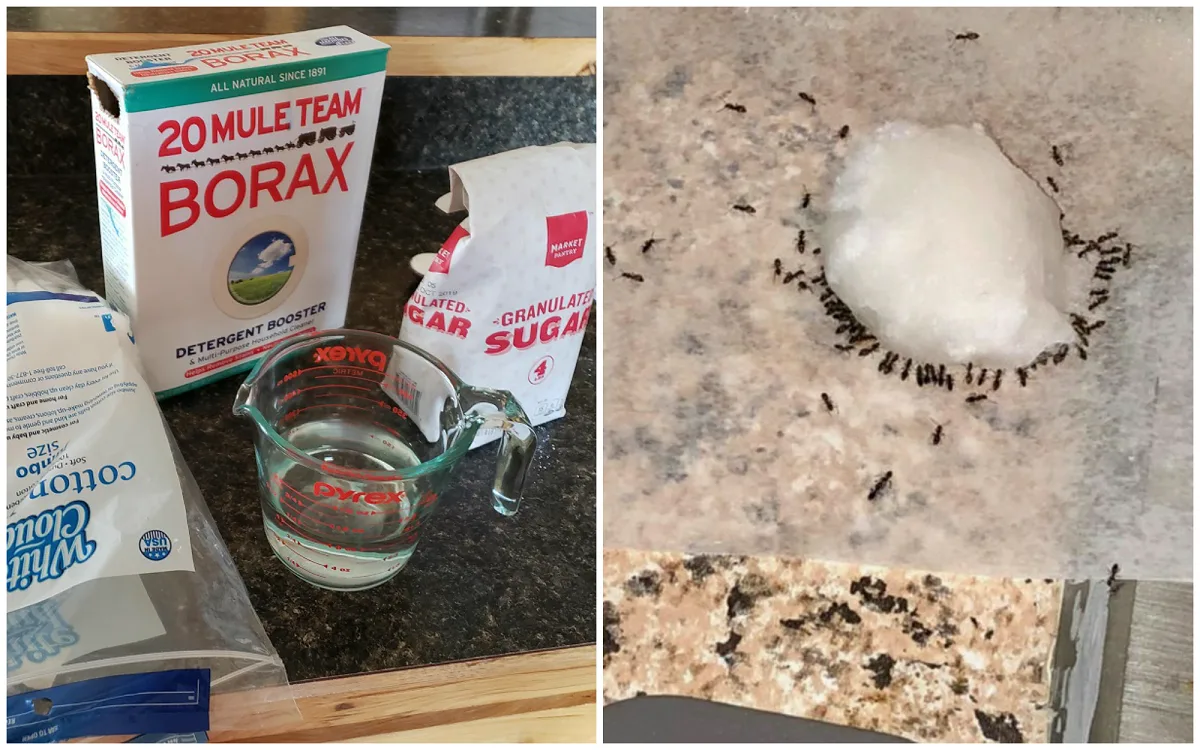
Mix one part borax with three parts sugar. Add a splash of hot water until it spreads like a thick syrup. Dab the paste on a small piece of cardboard.
Place it on the ant trail, not in an open bowl. Wait four to seven days for colony collapse.
Why Sprays Keep Failing and What Borax Actually Does to a Colony
The slow-kill mechanism (midgut, exoskeleton, brood starvation)
Insecticide sprays hit the exoskeleton. They knock down a worker in seconds. The queen, tucked two feet underground, never gets the hit.
The colony re-forages within a day. Borax works differently. Once ingested, it disrupts the midgut peritrophin membrane.
That membrane controls what gets absorbed into the ant's tissues. When it degrades, exoskeleton synthesis halts. The worker can't molt properly.
It starves from the inside over 48 to 72 hours.
Worker-only kill vs. colony collapse: what you're actually aiming for
Here's the if/then logic that separates bait from spray:
- If the ant dies at your kitchen counter, the colony is safe. You killed one out of 50,000 workers.
- If the ant carries a borax-laden sugar pellet back to the brood chamber, the queen and larvae are exposed. Brood development stalls. The colony shrinks within a week.
That second path is the entire game. You're not treating a trail. You're feeding a delivery system.
The sugar or protein is the vehicle. The borax is the payload. The ant is the courier.
The Four Ants You're Probably Dealing With (and Why It Changes Your Recipe)
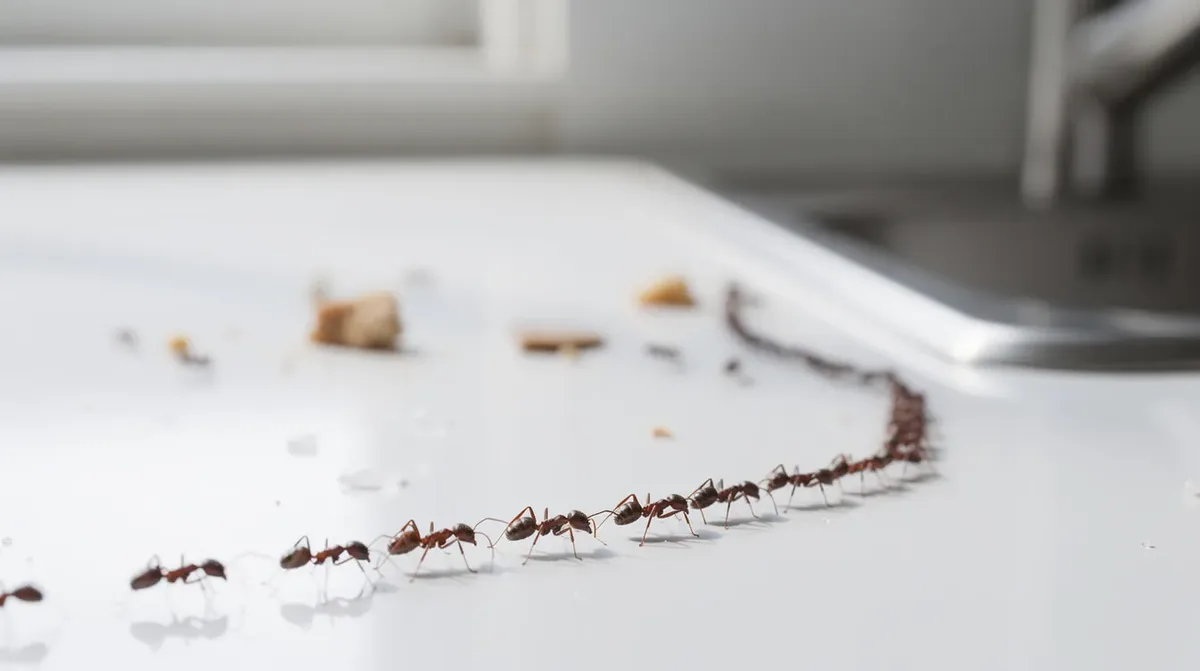
The recipe branches on species. If you skip identification, you'll mix the wrong base and the ants will simply forage somewhere else.
Odorous house ant (Tapinoma sessile)
Small (2.5 to 3 mm), pale brown, and they smell like coconut when crushed. They trail along baseboards, under sink cabinets, and around windows. They prefer sugar and carbohydrates.
Use the 1:3 borax-to-sugar paste. Indoor stations. This is the most common "kitchen ant" in the Northeast and Midwest.
Fire ant (Solenopsis invicta)
Rufous-orange workers, 2 to 6 mm, living in outdoor mounds 6 to 18 inches tall. They forage in open grass, not along your baseboard. They prefer a higher sugar ratio: 1:10 borax-to-sugar, in granular form, applied directly to the mound.
In our research across Texas A&M AgriLife Extension protocols, evening application matters because foragers retreat into the mound at dusk and drag the granules down with them.
Pharaoh ant (Monomorium pharaonis)
Tiny (1.5 mm), pale yellow head, two distinct knots on the petiole. They cluster behind bathroom tile, in electrical outlets, and around plumbing joints. Critical branch point: pharaohs reject sugar.
They want protein. Switch to a peanut butter or canned meat base, or the station sits untouched while they forage elsewhere.
Argentine ant (Linepithema humile)
Pale tan, 2 to 3 mm, multiple queens per supercolony. They trail on fruit trees, compost bins, and foundation cracks. They'll take either sugar or protein, but the 1:10 ratio outperforms 1:3 because they forage over wider areas and need a longer slow-kill window to carry the payload between nests.
Quick ID: size, smell, where the trail runs, and what they prefer
| Trait | Odorous | Fire | Pharaoh | Argentine |
|---|---|---|---|---|
| Size | 2.5–3 mm | 2–6 mm | ~1.5 mm | 2–3 mm |
| Smell | Coconut / pickle | No notable smell | None | None |
| Trail location | Baseboards, sink seams | Outdoor mounds, open grass | Behind tile, outlets | Trees, foundation cracks |
| Preferred base | Sugar (1:3) | Sugar (1:10) | Protein | Sugar or protein (1:10) |
If you can't tell them apart by eye, set out one sugar station and one protein station at the same trail point. Check after six hours. Whichever one has ant traffic is your base.
What Goes in the Mix: Borax, Base, Water, and Station Surface
Borax-to-sugar ratios: 1:3 vs. 1:10 and when each applies
The ratio controls kill speed. Too concentrated and the forager dies in the first hour, too far from the nest. Too dilute and the ant keeps foraging normally and the colony never sees enough payload.
- 1:3 (by weight): odorous house ants, ghost/sugar ants, general indoor kitchen work.
- 1:10 (by weight): fire ants, Argentine ants, or any species foraging over a wide area where you need the ant alive for 12+ hours.
A 2-lb box of borax (roughly $4 to $6 at most hardware stores as of 2026) gives you 30+ individual station batches at the 1:3 ratio.
Protein base swap: peanut butter, canned meat, egg yolk
If the species is pharaoh or you've tried sugar and got zero traffic, swap the base. Mix 2 tbsp smooth peanut butter with ½ tsp borax and a few drops of water. Stir to a spreadable log.
No sugar needed. The protein binds the borax into a paste that pharaohs will actually carry. Canned tuna or hard-boiled egg yolk works too, but peanut butter has the longest station shelf life (up to 48 hours in a humid room).
Water: just enough to dissolve, not a soup
This is the mistake that kills the whole attempt. Pour too much water and you get a thin, watery liquid. Ants lap it up at the trail edge, die there, and never carry it home.
You want a spreadable paste. Think runny honey, not apple juice. Hot water (about 140 °F) dissolves borax crystals faster.
Let the mix cool before you spread it, or the sugar base will seize into a hard bead.
Delivery surface: cardboard, wax paper, bottle cap, or commercial station
The surface controls drying time. A flat 3-inch square of corrugated cardboard holds moisture for 12 to 48 hours depending on room humidity. Wax paper dries faster.
A plastic bottle cap slides the ant off and dries in hours. If you have a commercial plastic bait station with a moisture-lid, that's the safest option for kitchens with kids, but a piece of cardboard taped down works fine in a garage or crawl space.
Why particle size (coarse vs. fine) changes shelf life
Coarse borax crystals (the kind sold in 2-lb boxes at the hardware store) dissolve slowly. They keep releasing active ingredient for longer, which extends station life. Fine powder dissolves in minutes, gives the ant its full dose in one visit, and the station goes inert within a day in dry air.
For a multi-day deployment, use the coarse grade and dissolve just enough to get a paste. Save the fine grade for one-shot applications where you need maximum dose in one forage.
Step-by-Step: Mixing, Placing, and Managing Indoor Bait Stations
Mix and cool
- Measure 1 part borax to 3 parts sugar (or 10 parts sugar for the 1:10 ratio). Weigh or use volume: 1 tbsp borax to 3 tbsp sugar is fine for a small batch.
- Add roughly 1 fl oz of hot water per 2 tbsp of borax. Stir until the crystals just disappear. You should have a thick, spreadable paste. If it pools and runs, add a pinch more sugar. If it's a dry crumble, add 2 drops of water.
- Let it cool to room temperature. Spreading hot paste on cardboard sets it into a hard bead that ants can't cut into.
Choose and prep the surface
Cut a 3-inch by 3-inch square of cardboard. Lay it flat on the counter or floor. Using the back of a spoon, spread a thin, even layer of the paste.
You want a film, not a dollop. The ant needs to walk through it and load up on its mandibles and gaster. A thick blob just sits there.
Place 2 to 4 stations on the observed foraging trail
Don't guess. Follow the actual trail you've been watching. Place stations directly on the pheromone path, not 12 feet off to the side.
Ants don't scout randomly; they walk a line. Put one station at the entry point, one mid-trail, and one near where the trail seems to thin out (often the nest entrance). For a small kitchen trail, two stations are enough.
For a longer run along a foundation wall, use three or four.
Manage moisture in dry (AC) vs. humid rooms
This is where people lose the deployment. In a 68 °F air-conditioned kitchen in July, the paste crusts over in 12 to 16 hours. You need to re-hydrate.
Keep a spray bottle of water nearby. Every 12 hours, mist the station lightly (2 or 3 spritzes) and re-spread with a toothpick. In a humid basement or a Florida bathroom, the opposite problem shows up: the station gets moldy or the sugar base ferments.
Cover the station with a damp (not wet) paper towel, weighed down with a coin. That extends shelf life to 48 hours and blocks mold.
The 48 to 96 hour wait: what to expect on days 1 through 7
- Day 1: You'll see foragers arriving, walking through the paste, leaving. They look normal. This is good. You want them alive and loading up.
- Day 2: Trail activity often increases. The queen's brood is still hatching workers, and those new workers hit the station fresh. Don't panic. Don't reset.
- Day 3 to 5: The trail thins. You may see a few dead or sluggish workers near the entry point. That's the payload hitting the brood chamber.
- Day 5 to 7: The trail should be essentially gone. If you see a new trail forming from a different direction, that's a satellite nest. Place two more stations at the new entry.
Read the result: trail gone, dead foragers at the entry, or no change
If the trail is gone by day 5, you've hit the colony. Wipe the station off, toss the cardboard, and seal the entry point (caulk, screen, weather-strip). If the trail is still heavy after day 7, two things are probably wrong.
Either the ratio was too concentrated (ants died on the spot) or you used sugar on a protein-preference species. Reset with the corrected base.
Fire Ant Mounds: A Different Workflow Entirely
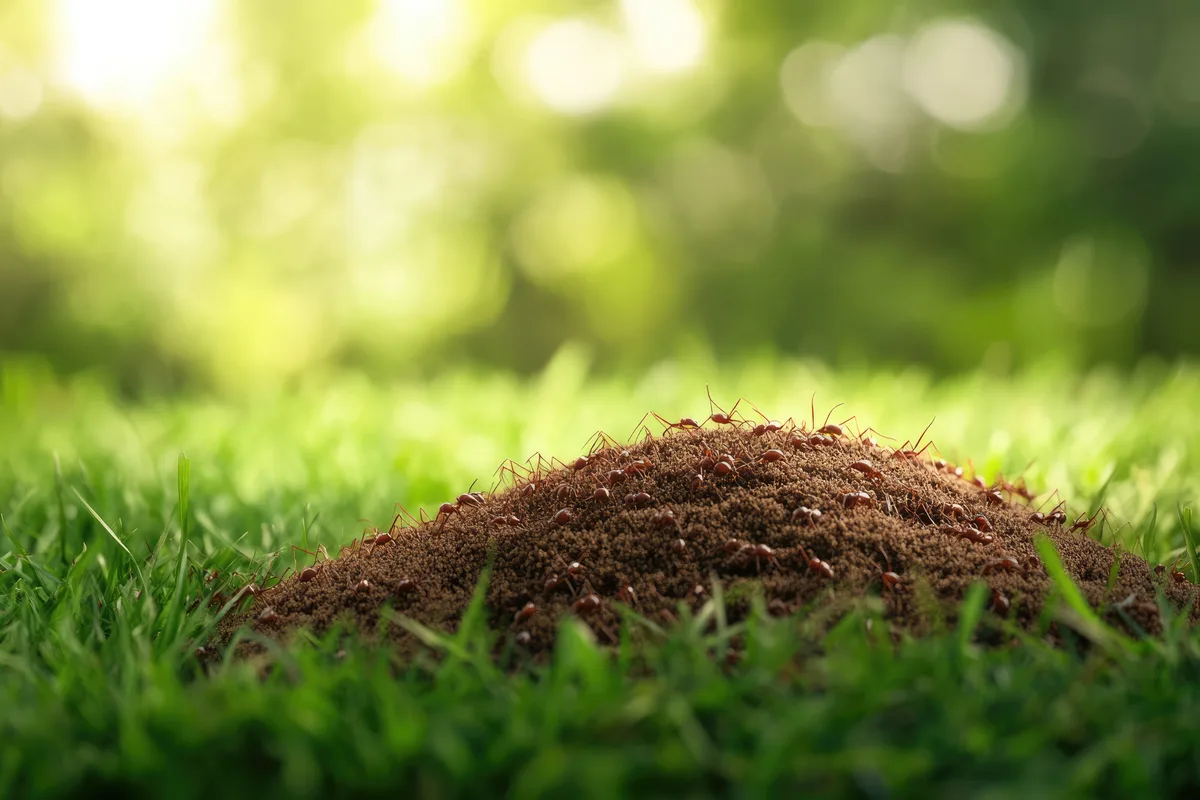
Indoor paste stations don't work on a fire ant mound. The foraging geometry is different. Fire ants work the mound in a radial pattern, and the queen sits 2 to 4 feet down.
You need the granules inside the mound structure, not on the lawn surface. The workflow below follows Texas A&M AgriLife Extension mound-treatment guidance.
Ratio shift to 1:10 and granular form
Mix 1 part coarse borax crystals to 10 parts white sugar. No water. You want a dry, free-flowing granular blend.
The sugar holds the borax on the ant's mandibles as it carries the mixture down into the mound. A wet paste would clump and sit on the surface where it dries before any ant touches it.
Evening application, 1 tablespoon per mound, 1 in deep
Work at dusk, when the surface foragers have retreated into the mound. Using a narrow spout or a clean index card, push roughly 1 tablespoon of the dry granule blend into a small depression in the mound's top. Don't pile it on the outside.
You want it in the tunnel network. If the mound is large (over 18 inches across), use 2 tablespoons and create two small depressions on opposite sides.
Keep kids and pets off treated mounds for 24 h
The granules are low-toxicity, but a dog digging through a fresh mound could ingest a meaningful amount. Tape off the mound, post a visible sign, and keep the area off-limits for 24 hours. After that, the granules have been drawn down into the tunnels and the surface risk drops to near zero.
Follow-up: when the mound cracks and re-treats are needed
You'll notice the mound losing structural integrity around day 4 to 6. Cracks appear. The top slumps.
That's the colony shrinking from the inside. If the mound holds firm past day 10, the queen didn't get enough payload. Re-treat with a fresh tablespoon.
For established mounds in warm climates (Gulf Coast, Texas, Southern California), plan on two treatment rounds spaced two weeks apart during peak foraging (May through September as of 2026). A third round is rare unless you have a satellite mound within 30 feet that's been colonizing since the first treatment.
The Two Critical Branches: Sugar Base vs. Protein Base
The base you pick determines whether the station gets traffic or sits ignored for a week. If the ant is odorous, sugar ant, or fire ant, run sugar. If it's pharaoh or you've already tried sugar with zero results, switch to protein.
Here's the fastest way to find out without guessing:
- Place one sugar-borax station and one protein-borax station at the same trail point.
- Check after six hours. Whichever has visible ant activity is your winner.
- Remove the loser. Keep the winner running for the full 48 to 96 hour window.
The protein stations (peanut butter, canned tuna, egg yolk) last shorter. In a dry AC room, re-hydrate or replace them every 12 hours. Sugar paste holds up to 48 hours if you keep it from crusting.
Mistakes That Reset the Clock
Most failed attempts trace back to one of these. Check your setup against the list before you blame the recipe.
- Ratio too concentrated. A 1:1 borax-to-sugar mix kills the forager on the spot. The colony never gets the payload. Dial back to 1:3 or 1:10.
- Liquid or dripping bait. Ants lap thin liquid at the trail edge, die on your counter, and the nest stays intact. You need a spreadable paste.
- Station off the pheromone line. Ants walk a trail. They don't scout in circles. If your station is 12 inches off the path, it's invisible to them.
- Resetting after 24 hours. You don't see dead ants yet, so you scrape the station and start over. Colony collapse takes three to seven days. Give it the full window.
- Competing pheromones on the same path. You sprayed DE or an essential-oil mist on the trail the morning before placing the station. The scent confuses the line and foragers detour.
- Clumped borax from a damp garage. Your measurements are off. Store the box in a cool, dry cabinet and sift out any clumps before mixing.
Borax vs. Commercial Gel Baits, Diatomaceous Earth, and Pro Treatments
| Method | Colony-level kill | Cost per treatment | Best fit |
|---|---|---|---|
| Borax DIY paste | Yes (3–7 days) | $0.10–$0.25 | Recurring indoor trails, mounds |
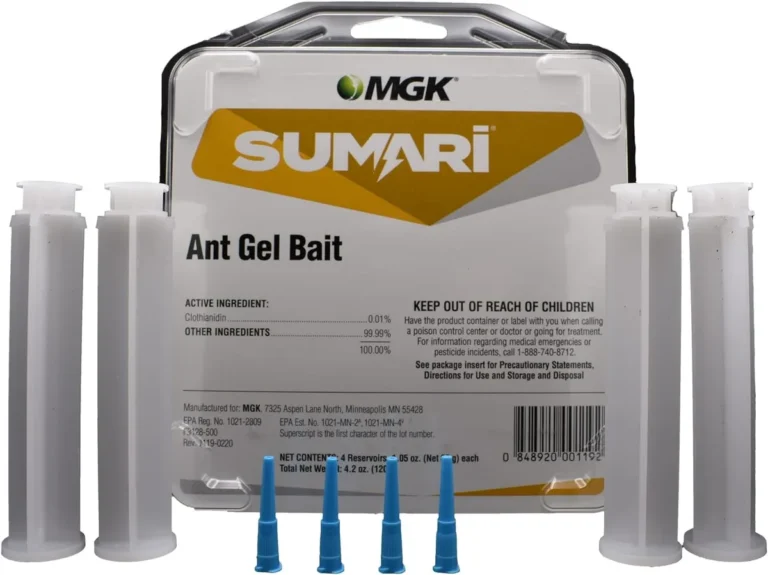
| Commercial gel (Terro, Amdro) | Yes (uses IGR or boric acid) | $6–$12 per station | Quick setup, no mixing |
| Diatomaceous earth | No (mechanical, dry only) | $8–$15 per lb | Damp-free crawl spaces, basements |
| Pro IGR mat / spray | Yes | $150–$350 per visit | Multiple species, established nests |
Borax wins on cost and transparency. You see exactly what's in the mix. Gel baits win on convenience if you'd rather not measure.
DE is useless in a humid kitchen. A pro visit makes sense when you've run three rounds of borax and the trail still shows up, or when you're dealing with a fire ant infestation covering more than ten mounds.
Keeping Kids, Pets, and Kitchen Counters Safe
Borax carries EPA FIFRA minimum-risk pesticide status (Registration No. 7445-419). That means it's allowed in your home without a commercial applicator license, but the label still limits where you put it. No food-contact surfaces, no lawns where kids play barefoot, no open stations within reach of a toddler's hands.
Practical rules:
- Store the raw borax box in a locked or high cabinet, not the pantry.
- Keep stations at least 30 inches off the floor or behind a low barrier a cat can't leap.
- Wipe any sugar-borax smear off counters before you prep food.
- A single lick from a cat or dog is negligible. A full station ingested by a small pet causes vomiting and diarrhea. Keep it out of reach regardless.
- Dispose of used cardboard and paste down the drain with running water. Don't dump a whole box into a storm drain.
If you swap borax for boric acid, the safety window narrows. Per CDC toxicity data, boric acid's oral LD50 is roughly ten times lower. Keep it strictly in locked storage and off any surface a child or pet can reach.
When to Reapply, Seal Entry Points, and Call a Pro
Peak foraging runs May through September in most of the US. Tropical zones (Florida, Texas Gulf Coast, Hawaii) forage year-round, so plan a monthly recheck rather than a one-and-done. In cold climates, ants go dormant below 40 °F.
A January station in a Minnesota kitchen is mostly pointless. Hold off until spring activity resumes.
After a successful treatment:
- Caulk window sills, screen gaps, and pipe penetrations where the trail originally entered.
- Weather-strip doors. Fill foundation cracks wider than 1/8 inch.
- Recheck the same spot in 14 days. A fresh trail means a satellite nest or a new foraging wave.
If you've completed three full borax cycles and the trail persists, or you've identified multiple species at once, that's the signal to bring in a professional with IGR bait mats and targeted foundation granules. Borax is your maintenance layer. It's not a replacement for structural treatment on a supercolony.
Frequently Asked Questions
Is borax the same as boric acid?
No. Borax is sodium tetraborate decahydrate. Boric acid (H3BO3) is roughly ten times more toxic to mammals.
Never swap one for the other without halving your dose.
Will borax kill the queen or just the workers?
The queen never forages. Workers carry the borax payload to the brood, stalling development. The colony starves top-down over three to seven days.
How long does a 2-lb box of borax last?
At the 1:3 ratio, about 30 to 40 station batches. Store the box in a dry, sealed cabinet and it stays usable for years.
Can I mix borax with vinegar or essential oils?
Don't. Vinegar degrades the crystal structure and weakens the payload. Oils repel foragers before they reach the station.
Keep the mix clean: borax, sugar or protein, a splash of hot water.
The Decision Guide: Match Your Situation to the Right Move
| Your situation | Move |
|---|---|
| Indoor sugar ants, Northeast kitchen | 1:3 sugar paste, 3 stations on the trail, 5-day wait |
| Pharaoh ants, Southern rental bathroom | Protein base behind the baseboard, no spray, 7-day window |
| Fire ant mounds, Texas lawn | 1:10 granules, evening, 1 tbsp per mound, 24-h keep-off |
| Recurring Argentine ant trail on a CA fruit tree | 1:10 granules, trunk band, monthly recheck |
| Three borax rounds done, trail still active | Call a pro for IGR mats and foundation granules |