Most personal bug sprays protect against mosquitoes for about 2 to 12 hours, depending on the active ingredient, product formula, and conditions. Always follow the protection time and reapplication directions on the product label.
In the United States, bug spray is a common part of outdoor plans. People use it for backyard cookouts, camping trips, fishing, hiking, gardening, and evenings on the porch. But one question often comes up after the first application: how long will that spray keep mosquitoes and other biting insects away? The answer depends on the product and how you use it.
A personal insect repellent is not the same as a household pest control spray. A lotion or aerosol made for skin may protect for several hours, while a yard treatment may remain active on certain surfaces for days or weeks under the conditions listed on its label. Some fabric treatments are designed to last through several washes. These products have different uses, so their protection times should not be mixed up.
The active ingredient matters, but so do sweat, swimming, rain, clothing, insect activity, and the amount applied. A product that works well during a calm evening may need more frequent attention during a hot, wet camping trip. Understanding these factors helps you plan without applying more pesticide than the label allows.
Source: zipzappestcontrol.com
How Long Does Bug Spray Last on Skin?
Most personal insect repellents provide protection for a few hours, although some products are labeled for much longer periods. A useful general planning range is about 2 to 12 hours. This is not a guarantee for every spray, and it should never replace the protection time stated on the specific product label.
The label may list different protection periods for mosquitoes, ticks, flies, or other insects. One product might protect against mosquitoes for longer than it protects against ticks. Read the full directions rather than assuming that one advertised duration applies to every pest.
Bug spray does not form an invisible shield that remains equally strong forever. Its active ingredients work while they are present and effective on the treated skin or clothing. As the product wears off, gets removed, or becomes less effective, biting insects may find exposed areas.
Source: campnewyork.org
Shorter protection
Some lower-duration products may need reapplication after a few hours. Check the stated protection period and maximum daily application limit.
Longer protection
Certain DEET and picaridin formulations can provide protection for many hours. The exact time depends on the formula and the insect named on the label.
Changing conditions
Heavy sweating, swimming, wiping the skin, and other activities can make the practical protection period shorter.
Why There Is No Single Protection Time
Two sprays with the same active ingredient can have different labeled protection times. Their concentrations, formulations, and intended uses may differ. A higher concentration can sometimes extend protection, but the relationship is not unlimited or identical across all products.
The insect also matters. Mosquitoes and ticks behave differently and may respond differently to the same repellent. For this reason, use the duration listed for the insect you need to avoid.
How Long Do Different Bug Spray Ingredients Last?
The active ingredient is one of the best clues to how long an insect repellent may work. Common ingredients in US personal repellents include DEET, picaridin, IR3535, oil of lemon eucalyptus, and related products made with PMD. Each has different formulas and label directions.
The ingredient alone cannot tell you the exact number of hours. Concentration, formulation, insect species, and use conditions all affect the result. Treat the ranges below as general context, not as a promise for every product.
Source: begardenly.com
DEET
DEET products are available in different concentrations and can provide protection for several hours. Some formulations offer extended protection, but the product label determines the stated duration and directions.
Picaridin
Picaridin is used in sprays and lotions that can provide several hours of mosquito and tick protection. The labeled duration varies by concentration and formulation.
IR3535
IR3535 is another registered repellent ingredient. Its protection time depends on the particular product and the insects it is designed to repel.
Oil of lemon eucalyptus and PMD
Some products containing oil of lemon eucalyptus or PMD provide several hours of protection. Check the exact ingredient and label because not every lemon eucalyptus product is an EPA-registered repellent.
Other plant-based formulas
Plant-based repellents can have shorter or more variable protection periods. Natural does not automatically mean longer-lasting or safer for every person.
Does More DEET Mean Longer Protection?
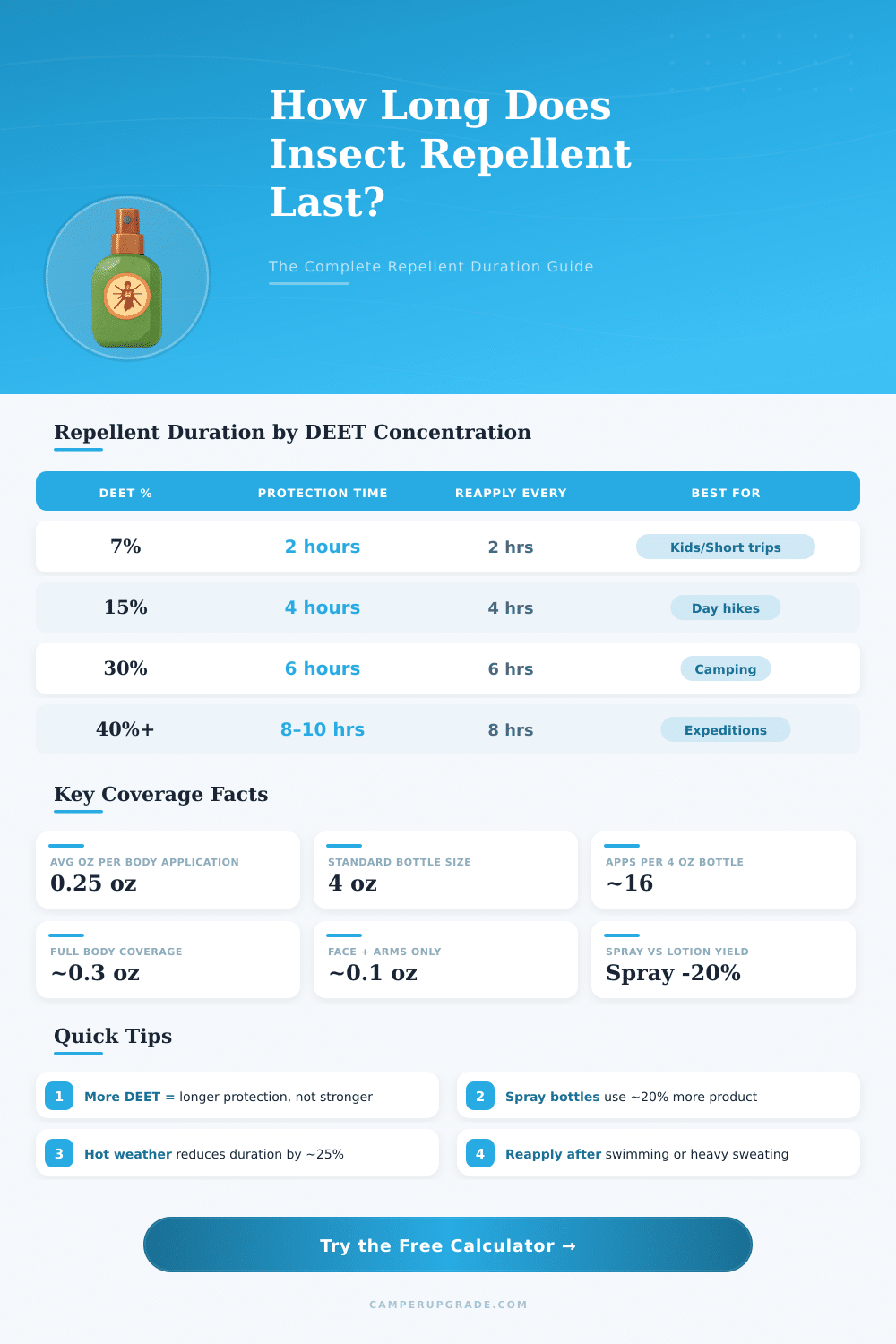
A higher DEET concentration can increase the length of protection in many formulations, but it does not mean protection increases in a simple, unlimited way. Moving from one concentration to another does not necessarily double the protection time.
Choose a concentration and product that fit the length of your activity. For a short walk, a lower-duration product may be enough. For a long outdoor trip, a product with a longer labeled protection period may be more practical. Follow the label’s age limits and application instructions in either case.
Does Picaridin Last as Long as DEET?
Some picaridin products offer protection times comparable to certain DEET products. However, there is no single answer for every brand or concentration. Compare the labeled hours for the same insect rather than judging by the ingredient name alone.
What Makes Bug Spray Wear Off Faster?
Several everyday conditions can reduce the useful protection you get from bug spray. The most important are water exposure, heavy sweating, rubbing, and the type of insect you are trying to repel. A product’s labeled protection period is based on its intended use, but real outdoor conditions can differ.
If you are spending hours outside in hot or humid weather, plan ahead. Carry the original product or keep its instructions available so you can check when reapplication is allowed. Do not guess at a new schedule or apply extra layers beyond the label directions.
Source: camperupgrade.com
Sweating
Heavy sweating may remove or reduce the repellent on treated skin. This is especially relevant during exercise, yard work, and summer hikes.
Swimming and water exposure
Water can wash some products away. Follow the label after swimming or bathing instead of assuming that the original application remains effective.
Rubbing and wiping
Towels, clothing, hands, and repeated skin contact can remove repellent from treated areas.
Rain and humidity
Rain may reduce protection, particularly if the product is not designed for water exposure. Humid weather can also increase sweating.
High insect activity
A large number of mosquitoes or ticks can make gaps in coverage more noticeable. Heavy insect activity does not mean you should exceed the label’s application limits.
Missed areas
Uncovered skin can attract bites even when nearby areas have been treated. Apply the product as directed to the exposed areas that need protection.
Does Rain Wash Bug Spray Off?
Rain can reduce the protection provided by a skin repellent, especially when water runs over treated areas or you wipe your skin afterward. Do not assume that a product is waterproof unless its label specifically supports that claim.
After substantial water exposure, read the directions to see whether another application is permitted. If the label gives no clear instruction for your situation, ask the manufacturer or a qualified health professional rather than repeatedly spraying.
Does Sweat Make Bug Spray Stop Working?
Sweat can affect how long some repellents remain on your skin. This does not mean every sweaty person needs immediate reapplication. Use the labeled protection time and any specific directions for exercise, water exposure, or repeated use.
How Long Does Bug Spray Last on Clothes?
The answer depends on whether the product is a personal repellent intended for clothing or a fabric treatment designed to bind to fibers. These are not interchangeable. Never assume that a skin spray can be used on every fabric or that a clothing treatment can be applied to skin.
Some clothing repellents are designed to work on exposed fabric for a limited period, while permethrin clothing treatments are made to remain active through a stated number of washes or a specified period of use. Follow the exact product instructions for treatment, drying, storage, and washing.
Source: the-independent.com
Regular personal repellent
Use on clothing only when the label permits it. The protection time depends on the product and may be affected by washing, rain, and wear.
Permethrin-treated clothing
Some products are designed to protect clothing through multiple washes. The label gives the wash limit or other duration instructions.
Factory-treated garments
Clothing treated by the manufacturer may have its own care and wash-life instructions. Check the garment label and product documentation.
Does Washing Remove Bug Spray From Clothes?
Washing can remove ordinary repellent from fabric and can reduce the effectiveness of some treatments. Permethrin products designed for clothing have specific wash-life claims, but those claims vary by product.
Do not add a new treatment after every wash unless the instructions call for it. Check the product’s stated wash limit and re-treatment method. Also keep treated clothing away from children and pets until it is completely dry, as directed.
How Long Does Bug Spray Last in the Yard?
Yard insecticide sprays can remain active for a different length of time from personal repellents. Depending on the chemical, surface, target insect, weather, and application method, some outdoor treatments may work for days or weeks. The product label is the only reliable guide to the approved treatment interval and use conditions.
A spray applied to leaves, grass, soil, or outdoor structures may behave differently on each surface. Sunlight, rain, irrigation, and plant growth can affect how long a treatment remains useful. A claim that a yard spray lasts for a certain number of weeks should not be applied to every product or every yard.
Source: campnewyork.org
Surface type
A treatment on a porous surface may behave differently from one applied to a nonporous surface. Follow the labeled site and surface restrictions.
Rain and irrigation
Water may reduce the remaining activity of some outdoor treatments. Check whether the product label includes rainfastness or watering instructions.
Sunlight and heat
Environmental exposure can affect pesticide residues. Do not assume that a treatment remains effective simply because the treated area still looks unchanged.
Target pest
A product labeled for one pest may not control another. Use only the pests and locations listed on the label.
When Should You Reapply Yard Bug Spray?
Reapply a yard treatment only when its label permits it and the stated interval has passed. More frequent spraying does not necessarily improve control. It can increase pesticide exposure to people, pets, wildlife, and beneficial insects.
If mosquitoes return soon after treatment, first look for standing water, clogged gutters, plant saucers, and other places where they may breed. Removing breeding sites can help reduce mosquito numbers without relying only on repeated chemical applications.
How Long Does Indoor Pest Control Spray Last?
Indoor pest control products are made for specific pests and surfaces, so their residual activity varies. Some products are designed to leave a residue that controls insects after the spray dries. Others work mainly when insects come into direct contact with the spray.
A residual insecticide may remain active for a period stated on its label, but that does not mean the treated room is unsafe for the entire period or that it is safe immediately after spraying. Re-entry, ventilation, food-contact surfaces, and cleaning instructions are separate label issues.
Never use an outdoor yard product inside your home unless its label specifically allows indoor use. Likewise, do not spray mattresses, toys, kitchen counters, pet bedding, or other sensitive areas unless the product label expressly permits that use.
Source: begardenly.com
Contact sprays
These products are intended to affect insects that are directly exposed to the spray. They may provide little or no lasting control once the application has dried.
Residual sprays
These products may leave an active residue on approved surfaces. Their useful life depends on the formula, surface, cleaning, and environmental conditions.
Aerosol products
Aerosol sprays vary widely. The application method does not tell you how long the product will remain effective.
How Long Should You Stay Out After Indoor Spraying?
There is no universal waiting time for every indoor insecticide. Some labels require people and pets to leave the treatment area until the spray has dried and the space has been ventilated. Other products may have additional restrictions.
Read the re-entry directions before applying the product. If the label says to leave the area for a stated period, follow that instruction even if the room looks dry. If exposure occurs or someone develops symptoms, contact Poison Control in the United States at 1-800-222-1222 or seek medical advice.
How to Tell When Bug Spray Needs Reapplication
The safest way to decide when to reapply is to use the product label, not the smell or feel of your skin. Many repellents have little noticeable odor after application, but that does not prove they have stopped working. Likewise, a strong smell does not prove that the product is still providing full protection.
Before going outside, check how many hours the product claims to protect against the insect you expect to encounter. Note the time of application and any label instructions about water, sweat, or repeat use. This simple habit can prevent both premature reapplication and long gaps in protection.
Source: camperupgrade.com
Check the stated duration
Find the protection time for the specific insect on the product label.
Review exposure
Consider whether you have been swimming, sweating heavily, or wiping the treated skin.
Check the application limit
Make sure another application is allowed and that you are not exceeding the daily maximum.
Cover missed areas safely
Use clothing, screens, or other protective measures instead of applying extra spray to areas that do not need it.
Does the Smell Tell You If Bug Spray Still Works?
No. Smell is not a dependable way to measure repellent effectiveness. Some active ingredients have little odor, and fragrance can remain after the useful protection period has changed.
Do not use smell as a reason to spray again. Use the label’s stated duration and reapplication instructions instead.
How Long Does an Opened or Unopened Bug Spray Bottle Last?
The useful life of a bottle is different from the protection time after application. An unopened product may remain usable until its stated expiration date when stored as directed. An opened bottle does not automatically expire as soon as you first use it, but its stability can depend on the formula and storage conditions.
Check the container for an expiration date, lot number, and storage instructions. Keep the product in its original container and away from excessive heat, direct sunlight, flames, and children. Do not transfer pesticide into a drink bottle or an unmarked container.
If the product has changed color, separated in an unusual way, leaked, or developed a damaged container, do not assume it is safe or effective. Contact the manufacturer for disposal or replacement advice. Follow local rules for pesticide disposal rather than pouring leftover product down a drain.
Source: the-independent.com
Expiration date
Use the printed date when one is provided. If there is no date, consult the manufacturer using the product name and lot number.
Storage conditions
Heat, sunlight, freezing, and container damage may affect product quality. Follow the storage range on the label.
Can condition
Do not use a leaking, badly rusted, swollen, or damaged aerosol container.
Can Expired Bug Spray Still Work?
An expired repellent may not provide the protection stated on its label. The amount of protection that remains cannot be judged reliably by appearance or smell alone.
If the date has passed, replace the product rather than relying on it for mosquito or tick protection. This matters most when bites may expose you to diseases carried by insects.
How to Use Bug Spray Safely and Get the Full Protection Time
Correct application helps a repellent work as intended and reduces avoidable exposure. Always read the complete label before use, including the directions for children, clothing, face application, and repeat applications. More product does not automatically mean better protection.
In the United States, EPA-registered insect repellents have label directions that explain approved uses. The Centers for Disease Control and Prevention also advises using registered repellents and following their instructions. Use the product only for the people, body areas, insects, and settings listed on the label.
Source: zipzappestcontrol.com
Apply to exposed skin as directed
Use only the amount and method stated on the label. Do not spray under clothing unless the label specifically directs it.
Protect your face
Do not spray directly onto the face. Apply the product to your hands first, then carefully spread it over the face while avoiding the eyes and mouth.
Keep it away from cuts and irritated skin
Do not apply repellent to wounds, rashes, or damaged skin unless the label specifically allows it.
Use sunscreen correctly
When both sunscreen and insect repellent are needed, apply sunscreen first and repellent afterward. Follow both product labels.
Wash treated skin when protection is no longer needed
When you return indoors, wash treated skin with soap and water, especially before bed.
Store the product safely
Keep the bottle in its original package, away from heat and flames, and out of reach of children.
Can You Apply Bug Spray to Children?
Children can use certain insect repellents, but the correct product and application method depend on the child’s age and the label. Adults should apply the product to their own hands first and then spread it on a child’s exposed skin when the directions call for that method.
Do not allow young children to handle repellent bottles or apply the spray themselves. Avoid children’s hands, eyes, and mouths. For infants, check the product’s age restrictions and use physical barriers such as mosquito netting where appropriate.
Is Natural Bug Spray Longer Lasting?
Not necessarily. Some plant-based products may provide shorter protection than certain registered repellents. The word natural is not a reliable measure of protection time, effectiveness, or safety.
For example, products made with oil of lemon eucalyptus are not the same as ordinary lemon eucalyptus essential oil. The active ingredient and formulation matter. Never assume that an essential oil mixture has the same protection time or approval as a registered repellent.
What Should You Do if Bug Spray Gets in Your Eyes or Is Swallowed?
Follow the first-aid directions on the label. If the product gets into the eyes, rinse with clean water as directed. If someone swallows it or develops a concerning reaction, contact Poison Control at 1-800-222-1222 in the United States or seek urgent medical care for severe symptoms.
Keep the container nearby when asking for help. The exact product and active ingredients can guide the advice given by Poison Control or a medical professional.
A Practical Bug Spray Duration Planning Guide
A simple plan can help you avoid both underuse and unnecessary reapplication. Start with the product’s stated protection period, then consider the activity and conditions. The examples below show how to think about timing without treating any estimated period as a universal rule.
For a two-hour backyard visit, a repellent labeled for several hours may cover the activity if it is applied correctly. For an all-day hike, choose a product with a suitable labeled duration and carry enough for permitted reapplication. If you swim or sweat heavily, check the label before deciding what to do next.
Source: campnewyork.org
Short outdoor activity
Check that the labeled duration covers the planned time outside. Apply according to the directions before exposure begins.
Long hike or camping trip
Choose a product labeled for the insects and duration you expect. Bring the original container and plan around its repeat-use limits.
Swimming or heavy exercise
Review the water and sweat instructions. Reapply only if the label allows it.
Overnight protection
Do not depend on a daytime application to protect you all night. Use screens, bed nets, and other barriers where appropriate, and follow the repellent label.
Example: Planning a Six-Hour Camping Trip
Imagine a camper plans to spend six hours outdoors. The chosen repellent label lists up to eight hours of mosquito protection under its stated conditions. The camper applies it correctly before going outside and avoids swimming or wiping the treated skin.
That camper should not automatically reapply at the four-hour mark just to be safe. The label’s duration and maximum application instructions should guide the decision. If the camper swims or experiences heavy sweating, the label’s directions for those conditions take priority.
Common Mistakes That Can Reduce Bug Spray Protection
A repellent may fail to provide the expected protection when it is used incorrectly or chosen for the wrong purpose. Small mistakes can leave exposed skin untreated or lead to unnecessary pesticide exposure. The best approach is to match the product to the insect, setting, and planned activity.
Source: begardenly.com
Using a household insecticide on skin
Indoor and yard insecticides are not personal repellents. Never apply them to your body unless the label specifically authorizes that use.
Assuming every spray lasts all day
Protection times vary. Read the product-specific duration instead of relying on a general claim.
Applying extra layers too often
Excessive application can increase exposure without extending protection. Follow the label’s repeat-use and daily maximum instructions.
Ignoring the target insect
A mosquito protection claim does not automatically establish the same duration against ticks or biting flies.
Using expired or poorly stored product
A damaged or expired product may not provide its stated protection. Check the date and storage instructions.
Forgetting physical protection
Long sleeves, pants, screens, and mosquito nets can reduce bites and help limit the need for repeated applications.
Frequently Asked Questions
Q
How many hours does mosquito spray last?
Mosquito repellents can protect for roughly 2 to 12 hours, depending on the active ingredient, concentration, and formulation. Some products may have shorter or longer labeled periods. Check the exact mosquito protection time on the package.
Q
Should I reapply bug spray every two hours?
Not always. Some products require more frequent applications than others, while some provide protection for several hours. Follow the product’s reapplication directions and maximum daily use limit rather than applying every two hours by default.
Q
Does bug spray work after sweating?
It may continue to work, but heavy sweating can reduce the amount of repellent remaining on the skin. Check the label for directions about exercise, water exposure, and repeat application. Do not exceed the stated limits.
Q
Does bug spray expire?
Yes, some products have a printed expiration date or a recommended shelf life. Storage conditions can also affect product quality. Follow the date and storage directions, and contact the manufacturer if the date or product condition is unclear.
Q
How long does DEET bug spray last?
DEET repellents can provide several hours of protection, with the exact period depending on the concentration and formulation. Read the product label for the duration against the specific insect you want to repel.
Q
Can I sleep with bug spray on?
It is generally best to wash treated skin with soap and water after coming indoors and when protection is no longer needed. Follow the product label, especially if you have sensitive skin or have used the repellent for an extended period.
Q
Does bug spray stop working when it dries?
No. A repellent does not necessarily stop working when it dries. Many products are intended to remain effective after application and drying. Use the labeled protection period rather than judging effectiveness by whether the skin feels wet.
✦ Wrapping Up
Conclusion
So, how long does bug spray last? For personal insect repellents, a useful general range is about 2 to 12 hours, but the exact answer depends on the active ingredient, product formula, target insect, and conditions. Sweat, swimming, rain, and rubbing can affect practical protection, while clothing treatments and household insecticides follow very different rules.
The product label is your best guide. Check the stated protection time, approved use, reapplication interval, age restrictions, and storage directions before applying the spray. Do not use a yard or indoor pesticide as a skin repellent, and do not apply extra product simply because insects are still present.
For longer outdoor activities, combine an appropriate registered repellent with practical barriers such as long clothing, screens, and mosquito nets. Remove standing water around your home to help reduce mosquito breeding. These steps can make outdoor time more comfortable while limiting unnecessary pesticide use.
💡 Key Takeaway
Before your next outdoor activity, check the active ingredient and labeled protection time on your bug spray, note when you apply it, and follow the instructions for reapplication and water exposure.