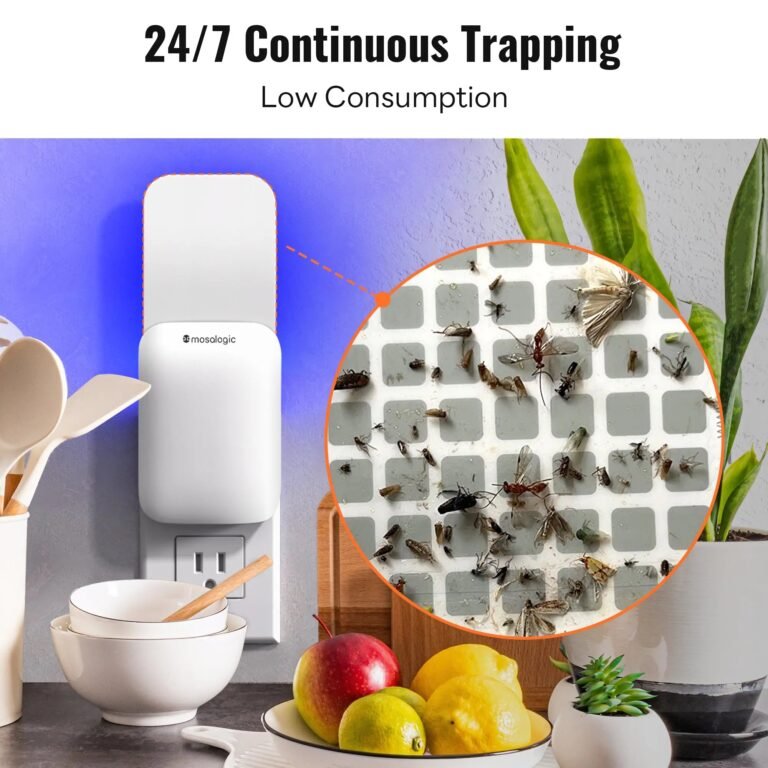
Most household bug zappers use about 10 to 40 watts, costing roughly a few cents per night and often less than $2 per month in the United States.
During a hot summer in the United States, mosquitoes, flies, and other flying insects can make a backyard, porch, or patio hard to enjoy. A bug zapper can help control some flying pests, but leaving an electric device running every night may raise a fair question: how much electricity does it actually use?
The answer depends on the model, its rated wattage, and how long it stays on. A small indoor plug-in unit may use around 10 to 20 watts, while a larger outdoor model may use 15 to 40 watts or more. Some commercial and multi-lamp machines use much more. These figures are useful starting points, not a replacement for the rating on your own device.
The good news is that many household bug zappers use far less electricity than large home appliances. Even an outdoor unit that runs for eight hours each night may add only a small amount to a typical electric bill. You can work out the cost with a simple formula and your local electricity rate.
How Much Electricity Does a Bug Zapper Use?
A typical household bug zapper uses around 10 to 40 watts while operating. Small indoor units often fall near the lower end of this range. Larger outdoor models may need more power because they use larger lamps, more than one light, or other electrical parts.
Watts measure how much power a device draws at a given moment. Kilowatt-hours measure the energy it uses over time. Your electric meter records energy use in kilowatt-hours, often shown as kWh on a U.S. electricity bill.
For example, a 20-watt zapper uses 20 watts while it runs. If you leave it on for eight hours, it uses 160 watt-hours, or 0.16 kWh. That is a small amount compared with many household appliances.
There is no single wattage that applies to every bug zapper. The product size, lamp type, motor, number of bulbs, and design all affect power use. The printed rating on the exact model is more useful than a general online estimate.
Small indoor units
Compact plug-in insect traps often use around 5 to 20 watts. Some fan-based or LED designs may use less.
Standard outdoor units
Many household outdoor grid zappers fall around 15 to 40 watts, depending on their lamp and overall design.
Large outdoor units
Larger units with several lamps or added features can draw 40 watts or more.
Commercial insect killers
Large machines used in restaurants, warehouses, and food service areas can have higher power ratings. Their actual rating must be checked individually.
Does Every Bug Zapper Use the Same Amount of Power?
No. Two bug zappers can look similar but have different electrical ratings. One may use a low-power LED lamp, while another may use a fluorescent UV tube and a larger electrical grid.
A device with two lamps may also use more electricity than a similar device with one lamp. A built-in fan can add another small load. For this reason, compare the full device rating rather than looking only at the bulb rating.
A useful example comes from published product specifications. Black Flag BZ-20 and related models list a 15-watt bulb for some units, while larger BZ-40 models list a 40-watt bulb. These are model-specific lamp ratings, not proof that every bug zapper in those size groups has the same total input.
Does a High-Voltage Grid Mean High Electricity Use?
No. A bug zapper can produce thousands of volts at its killing grid while drawing a modest amount of power from a household outlet. Voltage and power are different electrical measurements.
Voltage describes the electrical potential between two points. Wattage describes the rate of energy use. The grid is designed to deliver a high voltage with limited current, so its impressive electrical output does not mean the device must consume hundreds of watts.
This is why a small zapper can make a loud snap when an insect touches the grid without using as much electricity as a heater, hair dryer, or air conditioner.
How to Calculate Bug Zapper Electricity Consumption
You can calculate electricity use with one simple formula. Divide the wattage by 1,000, then multiply the result by the number of hours the zapper runs.
The formula is: Electricity used (kWh) = Wattage (W) × Hours of use ÷ 1,000.
For example, a 20-watt bug zapper running for eight hours uses 20 × 8 ÷ 1,000 = 0.16 kWh. If it runs for the same amount of time every night, multiply the daily figure by the number of nights in the billing period.
This calculation assumes that the device draws its rated power throughout the operating period. If the device has a variable operating mode, automatic shutoff, or a different measured input, actual consumption may differ.
Step 1: Find the wattage
Check the rating label on the zapper, its power adapter, or the manufacturer’s manual. Look for input power in watts.
Step 2: Estimate daily running hours
Work out how long the zapper stays on each day. Eight hours is a useful example for evening use.
Step 3: Calculate daily kWh
Multiply watts by hours and divide by 1,000.
Step 4: Calculate monthly use
Multiply daily kWh by the number of days the unit operates.
Step 5: Calculate the cost
Multiply the total kWh by the electricity price on your utility bill.
Example: A 20-Watt Bug Zapper Running for Eight Hours
Suppose you use a 20-watt outdoor bug zapper from dusk until bedtime. It runs for eight hours each night and operates for 30 nights.
Daily energy use is 20 × 8 ÷ 1,000, which equals 0.16 kWh. Monthly energy use is 0.16 × 30, which equals 4.8 kWh.
The U.S. Energy Information Administration reported an average residential electricity price of 18.16 cents per kWh for August 2026. Using that rate, the estimated monthly cost is 4.8 × $0.1816, or about $0.87.
This is an estimate based on a national average. Your actual cost depends on your utility, location, rate plan, taxes, and the device’s real power draw.
How to Calculate the Cost of Electricity
Once you know the energy use, calculating the cost is easy. Multiply the kWh by the price you pay for each kWh.
For a 20-watt zapper that uses 4.8 kWh per month, a rate of $0.20 per kWh would produce a monthly cost of $0.96. A rate of $0.30 per kWh would produce a cost of $1.44.
The same device can therefore cost different amounts in different U.S. states. A home in a high-rate area may pay more than a home in a lower-rate area, even when both use the same zapper for the same number of hours.
Cost formula
Monthly cost = Monthly kWh × Your electricity rate per kWh.
Check your bill
Use the energy rate that applies to your household instead of assuming the national average is your exact rate.
How Much Does a Bug Zapper Cost to Run?
For many U.S. households, the electricity cost of a small bug zapper is low. A 10-watt unit running eight hours a day uses 2.4 kWh over 30 days. At 18.16 cents per kWh, that is about 44 cents per month.
A 20-watt unit used for eight hours each night costs about 87 cents per month at the same rate. A 40-watt unit used for eight hours each night costs about $1.74 per month.
These examples show why wattage and operating time matter more than the appearance of the zapper. A larger model can use more electricity, but even a 40-watt household unit may have a modest running cost.
The estimates do not include the cost of replacement bulbs, repairs, or any additional device connected to the same outlet. They also assume the zapper operates at its stated wattage for the full period.
Daily, Monthly, and Yearly Electricity Costs
The following table compares three common example ratings. Each unit runs for eight hours per day for 30 days. The cost uses the EIA’s August 2026 U.S. average residential rate of 18.16 cents per kWh.
These are calculated examples, not measurements from a laboratory test. They help show how a change in wattage affects the bill when running time stays the same.
10-watt model
Uses 0.08 kWh per day, 2.4 kWh per month, and costs about $0.44 per month.
20-watt model
Uses 0.16 kWh per day, 4.8 kWh per month, and costs about $0.87 per month.
40-watt model
Uses 0.32 kWh per day, 9.6 kWh per month, and costs about $1.74 per month.
What If You Run a Bug Zapper for 12 Hours a Day?
Longer use raises energy consumption in direct proportion to the extra hours. A 20-watt zapper running for 12 hours uses 0.24 kWh per day.
Over 30 days, that becomes 7.2 kWh. At 18.16 cents per kWh, the monthly cost is about $1.31.
A 40-watt model running for 12 hours per day uses 14.4 kWh per month and costs about $2.61 at the same rate. The increase is easy to predict because the wattage and running time both appear in the formula.
Bug Zapper Electricity Use by Type
The type of bug zapper affects how much electricity it uses. A compact indoor plug-in trap has a different job from a large outdoor grid unit. Some products attract insects with UV light, while others use a fan to draw insects into a collection chamber.
A lamp-based zapper mainly uses electricity for its light and high-voltage grid. A fan-based trap also powers a motor. A combination model may use more than one feature at the same time.
The ranges below are general planning examples. They are not fixed limits for each product category. Always use the input rating on the exact model when calculating a real bill.
Indoor plug-in bug zappers
Small indoor models may use around 5 to 20 watts. Their low power draw can make overnight use inexpensive.
Outdoor electric grid zappers
Common household outdoor units may use around 15 to 40 watts, with larger models using more.
LED bug zappers
LED designs can use less power for their light source than some traditional fluorescent designs. The full device rating still determines total use.
Fan-based insect traps
These units use a motor to pull insects into a collection area. Their total power use depends on the motor, light, and other parts.
Solar bug zappers
Solar models charge an internal battery from sunlight. When they run from stored solar energy, they do not draw operating power from a household outlet.
Large commercial units
Commercial insect-control machines can use substantially more power. Their size, lamp count, and operating features must be checked on the rating plate.
Do LED Bug Zappers Use Less Electricity?
LED bug zappers can use less electricity for lighting than some older lamp designs. LEDs convert electrical energy into light differently from fluorescent tubes, and the light source may need less power for a similar lighting task.
However, the LED label alone does not tell you the total power use. The device may also have a fan, transformer, control circuit, or other parts. Compare the full input wattage of each model rather than comparing bulb wattage alone.
A lower-wattage model will generally use less energy when both devices run for the same number of hours. That does not automatically mean it will catch the same number or type of insects.
Do Solar Bug Zappers Use Electricity From the Grid?
A solar bug zapper usually stores energy in a rechargeable battery. Its solar panel charges the battery during daylight, and the device uses stored energy after dark.
This means the zapper may add no direct electricity use to your household bill when it runs only on solar-charged battery power. However, cloudy weather, panel size, battery capacity, and operating time can affect how long it works.
If a solar model also has a USB charging option, charging it from a wall adapter will use some household electricity. The amount depends on the battery capacity and charging efficiency.
What Factors Affect Bug Zapper Power Consumption?
Several factors affect how much electricity a bug zapper uses. The biggest are its wattage and the number of hours it stays on. Other design features can also change the total.
A small zapper with a 10-watt rating may use less energy than a large 40-watt unit, even if both run for the same time. But a small device left on all day may use more energy than a larger device switched on for only a few evening hours.
Think of electricity use as a combination of power and time. A low-power device running for many hours can still add up, while a higher-power device used briefly may consume less overall.
Rated wattage
The wattage is the starting point for the calculation. A higher input rating generally means more energy use per hour.
Daily operating hours
A zapper running for 12 hours uses 50% more energy than the same zapper running for eight hours.
Number of lamps
Multiple lamps can increase the electrical load, depending on their ratings and how they operate.
Built-in fans
A motor adds to the total power draw. Check the complete device rating rather than the lamp rating alone.
Automatic controls
Timers, light sensors, and automatic shutoff features may reduce operating time. Their own standby use, if any, is usually small but depends on the design.
Electricity price
Your utility rate changes the cost, even when the zapper uses the same amount of energy.
Does the Weather Affect Electricity Use?
Weather does not automatically change the rated wattage of a standard bug zapper. However, it can change how long you choose to run the device and how often insects are active around your home.
Warm evenings may lead to longer use during mosquito season. Rain can also affect outdoor operation. Never assume that a unit is safe to leave exposed to wet conditions unless its manufacturer specifically rates it for the location and conditions.
If you use an outdoor zapper with an approved weather-resistant design, follow the installation instructions. Keep plugs and connections protected as directed, and avoid using damaged cords or electrical equipment in wet areas.
Does a Dirty Bug Zapper Use More Electricity?
A dirty grid or collection tray does not automatically mean that every bug zapper draws more power. However, insect debris can interfere with operation, block airflow in fan-based models, or cause repeated sparking in some designs.
Clean the unit as directed in its manual. Unplug it first, allow the specified waiting period, and never use water or liquid cleaners unless the manufacturer clearly permits them.
If the zapper makes unusual noises, shows damaged wiring, or continues to spark in a way the manual does not describe, stop using it and seek manufacturer support or qualified service.
How to Reduce Bug Zapper Electricity Costs
You can reduce electricity use by controlling how long the bug zapper operates and choosing a model with a suitable power rating. You do not need to leave every zapper running around the clock.
First, think about when flying insects are most active around your property. If you mainly use the patio in the evening, a timer may help limit operation to the hours that matter. Follow the manufacturer’s instructions before using an external timer.
Next, check whether the zapper is placed correctly. Poor placement may make it less useful, which can tempt you to leave it running for longer. Follow the instructions for distance from people, food, doors, and outdoor living areas.
A lower-wattage model may reduce energy use, but power consumption is only one part of the decision. The device must also be suitable for the insects and area you want to manage.
Use a timer
Set the zapper to operate during the hours when you need it, if the manual permits timer use.
Avoid unnecessary 24-hour operation
Switch the device off when it is not needed, unless the manufacturer’s directions require continuous operation.
Choose the right size
Do not pay to run a large unit when a smaller model is suitable for the intended area.
Compare full input ratings
Check the complete device wattage rather than choosing a model based only on its bulb rating.
Maintain the device
Remove insect debris and replace worn parts according to the manual so the unit can operate as intended.
Consider solar power
A suitable solar model may avoid direct household electricity use, although battery and sunlight limits still apply.
Should You Turn Off a Bug Zapper During the Day?
If the device is not needed during daylight hours, turning it off can reduce electricity use. A zapper that runs for eight hours instead of 24 hours uses one-third as much energy over the same number of days, assuming the same wattage.
For example, a 20-watt unit running for eight hours uses 0.16 kWh per day. The same unit running for 24 hours uses 0.48 kWh per day.
However, some pest-control plans may require a different operating schedule. Follow the product instructions and consider when the target insects are active in your area.
Can a Smart Plug Reduce Electricity Use?
A compatible smart plug can help control operating hours. You may schedule the zapper to switch on in the evening and off later at night.
Check the smart plug’s electrical rating before connecting it. Its voltage, current, and wattage limits must be suitable for the zapper. Outdoor use also requires a smart plug specifically rated for outdoor conditions.
A smart plug does not make the zapper more energy-efficient while it is running. It saves energy by reducing the number of hours the device stays on.
How to Find the Actual Wattage of Your Bug Zapper
The most reliable way to estimate your zapper’s electricity use is to find its rated input power. Do not rely only on the wattage stated in a product title or on the lamp itself.
Look for a rating label on the back, bottom, or side of the housing. Some models print their electrical information near the power cord or on a separate adapter.
If the label lists volts and amps but does not show watts, you can estimate power by multiplying voltage by current for a simple single-phase AC rating. However, power factor and the type of load can affect the exact result, so a wattage figure from the manufacturer is preferable.
The manual or manufacturer’s support page may list the input rating. Match the exact model number because different versions can use different lamps or electrical parts.
Check the product label
Look for input watts, voltage, and current. Use the complete appliance input rating when available.
Read the owner’s manual
Check the specifications section for the model’s rated power and operating requirements.
Check the adapter
For a low-voltage plug-in model, inspect the adapter label and the manufacturer’s information to determine the device’s input rating.
Use a plug-in power meter
A suitable energy meter can measure consumption over a set period. Use it only with equipment and outlets within its electrical rating.
Is Bulb Wattage the Same as Total Bug Zapper Wattage?
Not always. A bulb rating describes the lamp, while the full device may also use electricity for its grid, motor, power supply, and controls.
For example, a manual may list a 40-watt bulb as a product specification. That figure should not automatically be treated as an independently verified measurement of total wall-outlet consumption.
For an accurate bill estimate, use the appliance’s stated input power. If only the lamp wattage is available, label your calculation as an estimate rather than an exact measurement.
Can You Measure Electricity Use With a Watt Meter?
Yes. A properly rated plug-in energy meter can show the power draw of a compatible bug zapper and may record total kWh over several hours or days.
Plug the meter into a suitable outlet, connect the zapper according to the meter instructions, and read the energy total after a normal operating period. The reading can help account for actual operating behavior rather than relying only on a label.
Never open the zapper or connect test leads to its high-voltage grid. The grid can cause an electric shock. If the device or outlet shows damage, stop the test and contact a qualified professional.
Common Mistakes When Estimating Bug Zapper Electricity Use
A small calculation error can make an electricity estimate look much higher or lower than it should. The most common mistakes involve confusing watts with kilowatt-hours, using the wrong rating, or forgetting to multiply by the number of operating days.
Remember that watts measure power, while kWh measures energy. A 20-watt device does not use 20 kWh every hour. It uses 0.02 kWh for each hour it operates at a steady 20-watt draw.
Another mistake is assuming every model uses the same amount of power. A small LED trap, a 40-watt outdoor zapper, and a commercial insect killer are not interchangeable.
It is also easy to use a national average electricity price as though it were your own rate. Treat national figures as examples and use your utility bill for a better estimate.
Mistake: Confusing watts and kWh
Correction: Divide watts by 1,000 before multiplying by hours to calculate energy use.
Mistake: Forgetting operating time
Correction: Include the actual hours per day and days per month.
Mistake: Using bulb wattage as total input
Correction: Check the full appliance rating when possible.
Mistake: Ignoring local electricity rates
Correction: Use the price per kWh shown on your own utility bill.
Mistake: Treating an estimate as a measured result
Correction: State the assumptions clearly or measure consumption with a suitable energy meter.
Does Leaving a Bug Zapper Plugged In Use Electricity When It Is Off?
It depends on the design. A basic mechanical switch may disconnect most of the device’s electrical load, while an electronic model with a standby circuit or remote control may draw a small amount of power when switched off.
If you want to know whether standby use matters, check the manual or measure the device with a suitable energy meter. Do not assume that every model has zero standby consumption.
For many small devices, standby use is likely to be much lower than the energy used during active operation. However, the exact amount is model-specific.
Can a Bug Zapper Increase Your Electric Bill Noticeably?
A typical small household zapper is unlikely to create a large increase in an electric bill on its own. For example, a 20-watt unit running eight hours per day uses only 4.8 kWh over 30 days.
At 18.16 cents per kWh, that is about 87 cents. A larger model, longer operating schedule, or higher local rate can raise the cost.
If your bill rises much more than expected, check other appliances and the total household usage before blaming the zapper. A small insect-control device is only one part of a home’s electrical load.
Electrical Safety When Using a Bug Zapper
Bug zappers use electrical circuits and high-voltage grids, so safe use matters more than saving a few cents. Follow the product manual, use the correct outlet, and keep the device away from water unless it is specifically rated for the intended outdoor conditions.
Never touch the grid while the unit is connected to power. Unplug the zapper before cleaning, removing insect debris, changing a bulb, or performing any maintenance. Follow the waiting period in the manual because some electrical components may retain a charge after unplugging.
Keep children and pets away from the unit. Do not insert tools, fingers, or other objects through the protective housing. Also keep the zapper away from flammable materials and areas where insects or debris could create a fire risk.
For outdoor installations, use an extension cord and outlet suitable for outdoor conditions when the manufacturer permits them. Do not use a damaged cord, loose plug, cracked housing, or exposed electrical connection.
Unplug before cleaning
Disconnect the unit from the outlet before removing debris or servicing it.
Keep the unit dry
Follow the exact weather-resistance and placement instructions. Do not assume every outdoor-looking model can withstand rain.
Protect children and pets
Place the device where they cannot reach the grid or power cord.
Avoid damaged equipment
Stop using a zapper with a damaged housing, cord, plug, or electrical connection.
Do not repair the high-voltage grid yourself
Use the manufacturer’s service process or a qualified technician for electrical faults.
Can You Leave a Bug Zapper Running Overnight?
You can leave a bug zapper running overnight only when the manufacturer permits that use and the installation meets the product’s safety requirements. Many household models are designed for extended operation, but this must be confirmed for the exact unit.
Check whether the device is suitable for indoor or outdoor use, whether it has the required protective housing, and whether its power cord and outlet are in good condition.
For outdoor use, keep the unit away from standing water and protect the electrical connection as instructed. Switch it off if it becomes wet beyond its stated rating or shows signs of damage.
Does Low Electricity Use Mean a Bug Zapper Is Completely Safe?
No. Low energy consumption does not remove electrical hazards. A small device can still have a high-voltage grid capable of causing an unpleasant or harmful shock.
Keep the unit intact and use its protective housing as designed. Never bypass safety features or try to test the grid with your fingers or a metal object.
If you notice overheating, smoke, a burning smell, repeated abnormal arcing, or damaged wiring, disconnect power if you can do so safely and stop using the device. Seek qualified help when needed.
What the Available Product and Energy Evidence Tells Us
Published product manuals show why one universal wattage figure would be misleading. The Black Flag BZ series manual lists 15-watt bulbs for some models and 40-watt bulbs for others. A separate PIC 40-watt bug zapper manual also identifies a 40-watt bulb.
These specifications establish the lamp ratings for those named products. They do not establish the exact power use of every zapper or prove that all products with a 40-watt bulb draw exactly 40 watts from the outlet.
The U.S. Energy Information Administration reported an average U.S. residential electricity price of 18.16 cents per kWh for August 2026. This gives a useful national reference for cost examples, but local rates can differ.
A practical improvement over a simple wattage estimate is to show both the formula and the assumptions. Readers can then replace the example wattage, running hours, and electricity price with the figures that apply to their own homes.
Documented product specifications
Named Black Flag and PIC manuals provide examples of 15-watt and 40-watt lamp ratings.
Official U.S. energy data
The EIA’s August 2026 residential electricity price provides the national reference used in the sample calculations.
Calculated examples
Daily and monthly costs in this guide are mathematical estimates, not hands-on measurements of a specific zapper.
Important limitation
The supplied image list contains no bug zapper photographs, and no first-hand product testing was provided for this article.
Reader Questions That Deserve More Than a Wattage Estimate
A useful electricity guide should answer more than how many watts a zapper uses. Readers also need to know how to find the right rating, how long to operate the device, and how to convert energy use into a real bill estimate.
The main next-step questions are addressed throughout this article: how to distinguish bulb wattage from total input, how to account for standby use, whether solar operation affects the household meter, and whether a timer can reduce operating hours.
These questions are practical extensions of the main topic. They are not presented as verified search-volume trends or as a complete survey of all competing pages.
Observed documentation gap
Some product specifications list bulb wattage without clearly establishing total wall-outlet input. The article explains why readers should check the full device rating.
Inferred next need
A reader who calculates monthly cost may also need to know how to measure real consumption. The power-meter section explains a safe method.
Inferred next need
A reader concerned about overnight use may need electrical safety guidance. The safety section covers placement, unplugging, and damaged equipment.
Frequently Asked Questions
Q
How much electricity does a bug zapper use per hour?
A 10-watt bug zapper uses 0.01 kWh per hour. A 20-watt model uses 0.02 kWh per hour, while a 40-watt model uses 0.04 kWh per hour.
The actual amount depends on the full input rating of your device. Check the rating label or manual for the correct figure.
Q
How much does it cost to run a bug zapper for one night?
A 20-watt bug zapper running for eight hours uses 0.16 kWh. At the August 2026 U.S. average residential electricity price of 18.16 cents per kWh, that costs about 2.9 cents for one night.
Your cost may be higher or lower because electricity rates vary by utility and location.
Q
Does a bug zapper use more electricity than a fan?
It depends on the wattage of both devices. A 20-watt bug zapper uses less power than a 60-watt fan while both operate, assuming their actual draws match those ratings.
A larger commercial zapper may use more than a small fan. Compare the input wattage on both product labels to make a fair comparison.
Q
Can a bug zapper run all night without using much electricity?
Many household bug zappers use a modest amount of electricity, even during overnight operation. A 20-watt model running for 12 hours uses 0.24 kWh.
At 18.16 cents per kWh, that is about 4.4 cents per night. Only run the device overnight when its manual permits continuous use and the installation is safe.
Q
Do bug zappers increase your electric bill?
Yes, a plug-in bug zapper adds some electricity use to your home. However, a small household model will often add less than a few dollars per month when used for several hours each day.
The exact increase depends on wattage, running hours, and your local electricity price.
Q
Is a 40-watt bug zapper expensive to run?
Usually, a 40-watt household zapper is not expensive to run compared with many larger appliances. At eight hours per day for 30 days, it uses 9.6 kWh.
At 18.16 cents per kWh, the estimated monthly electricity cost is about $1.74. A higher local rate or longer operating schedule will increase that amount.
Q
Does a bug zapper use electricity when it is switched off?
Some electronic models may draw a small standby load when switched off but remain plugged in. Other designs may disconnect most or all of their internal circuits.
Check the manual or use a suitable plug-in energy meter if you need to know the exact standby consumption.
Q
Are solar bug zappers cheaper to run?
Solar bug zappers can avoid direct household electricity use while operating from a solar-charged battery. This can make their running cost on your home electric bill very low.
However, battery replacement, product cost, sunlight, and charging performance still matter. A solar unit may not provide the same operating time in every weather condition.
✦ Wrapping Up
Conclusion
Most household bug zappers use around 10 to 40 watts, although the exact figure depends on the model. For many homes, this means a small electricity cost, even when the device runs for several hours each night.
The easiest way to estimate your cost is to multiply the zapper’s wattage by its operating hours, divide by 1,000, and multiply the result by your electricity rate. A 20-watt unit running eight hours each night uses 4.8 kWh over 30 days and costs about 87 cents at the August 2026 U.S. average rate of 18.16 cents per kWh.
Do not assume that bulb wattage always equals total device consumption. Check the full input rating, follow the manufacturer’s instructions, and use a suitable energy meter if you need a more accurate measurement. A timer can also reduce energy use by limiting unnecessary operating hours.
A bug zapper is generally a modest electrical load compared with large household appliances. Still, the best estimate comes from your own device’s rating and your actual utility rate.
💡 Key Takeaway
Check the input wattage on your bug zapper, record how many hours it runs each day, and calculate monthly use with this formula: watts × hours per day × days ÷ 1,000. Multiply the result by your electricity rate to estimate the cost.
Will fire ant killer kill regular ants? Learn how fire ant baits work, which ants they affect, why results vary, and how to choose the right ant control product.